New York offers far more than the fast-paced lifestyle of New York City. Across the state, residents can choose from affordable small towns, thriving college cities, scenic mountain communities, and family-friendly suburbs. Whether you’re planning to retire, start a career, raise a family, or simply enjoy a lower cost of living, the Empire State provides a wide range of options.
Quick Guide
- State: New York
- Best For: Families, Professionals, Retirees, Students
- Median Home Prices: Approximately $92,000–$215,000
- Top Industries: Health Care, Education, Manufacturing, Government, Retail
- Outdoor Highlights: Adirondack Mountains, Lake Ontario, Finger Lakes, Hudson River, Urban Parks
- Best Time to Relocate: Spring through Fall for easier home shopping and moving
- Ideal For: Buyers seeking affordability, career opportunities, and outdoor recreation
- Source: worldatlas
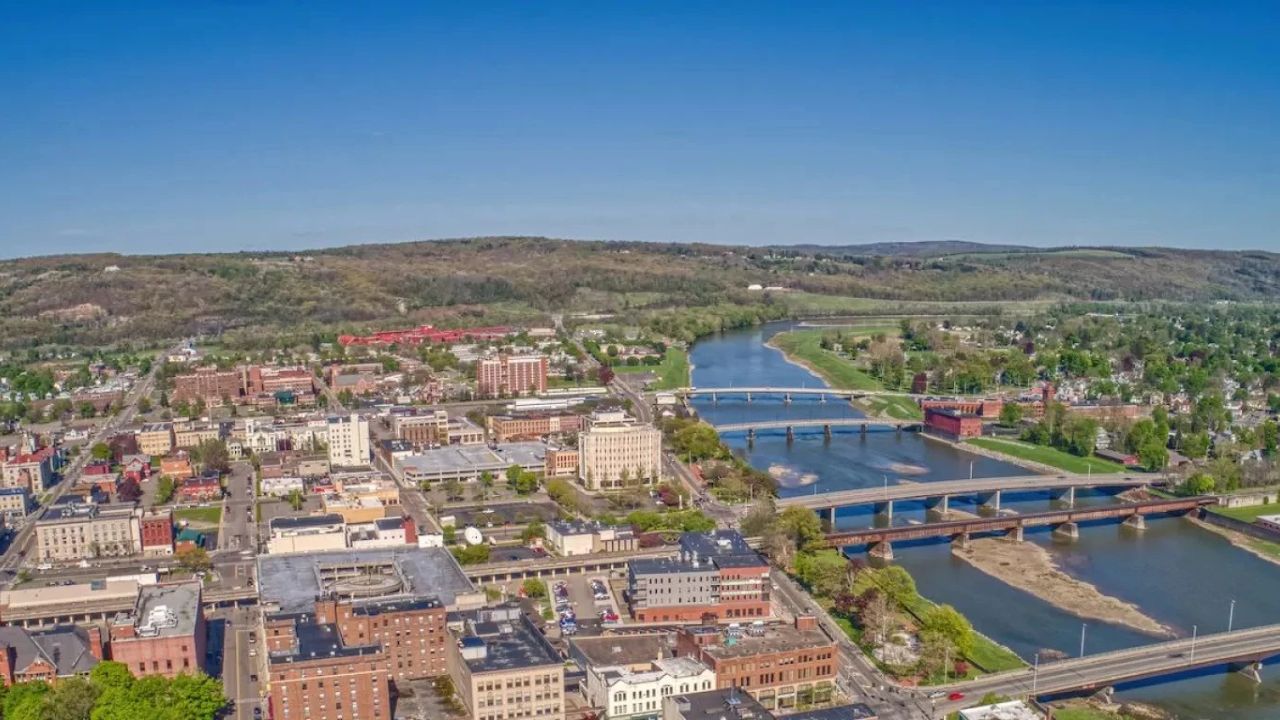
This ranking considers several important factors, including median home prices, local economies, employment opportunities, education, public safety trends based on FBI Crime Data Explorer reports, and overall quality of life. While every community has its strengths and challenges, these seven New York destinations stand out as some of the best places to live in 2026.
7. Glens Falls
Glens Falls is a city of 12,650 people on the Hudson River. As it is on the outskirts of the Adirondack Mountains and within close proximity to Lake George, Glens Falls creates opportunities for its residents to live active lifestyles. Lake George Beach allows for passive and active recreation, equipped with picnic tables, grills, volleyball courts, a swimming area, a boat launch, and a sandy beach for relaxing. Glens Falls is an excellent choice for retirees seeking a balance of natural scenery, safety, and everyday convenience.
Median home value in Glens Falls is $215,182. Glens Falls’ economy is heavily driven by health care and social assistance, education, and retail, while its highest paying employers are real estate, rental, and leasing, public administration, and construction.
Homicide rates in Glens Falls over the last five years have consistently been below both the state and national levels. Aggravated assault rates have also been consistently low. The Glens Falls City School District covers five schools. Kensington Road School is the top-rated school in Glens Falls. Proficiency in both math and reading is higher than the state average.
6. Cheektowaga
Cheektowaga is the second-largest suburb of Buffalo, with a population of 75,136 people. Residents can expect median home value prices of $191,963. The largest industries in Cheektowaga are health care and social assistance, manufacturing, and retail. The highest paying industries are utilities, public administration, and professional, scientific, and technical services.
Rates of aggravated assault levels in Cheektowaga have been consistently lower than state and national averages, with a couple of periods in the last five years when it was on par with the national level, but still lower than the state level. Homicide rates have also been mostly low, except for a few spikes over the last five years. The Cheektowaga Central School District fosters high standards, technology integration, and personal student development. Consequently, around 85% of its graduates attend college.
There are many town parks in Cheektowaga that offer the community recreational opportunities. Stiglmeier Park is laced with trails which are open year-round. With green space, low crime, and a stellar school district, Cheektowage may be the optimal choice for families.
5. Rochester
Rochester is a city in Monroe County of 217,775 people that sits on the south shore of Lake Ontario. The largest industries are healthcare and social assistance, education, and retail. The largest employers include the University of Rochester, Sutherland Global Services, and Carestream Health Inc. The median home value in Rochester is $160,967.
The Greater Rochester Area is home to 18 colleges and universities that contribute to an educated local workforce, of which over 90% have a high school degree or equivalent, and 66% have some form of college education. Additionally, 37.8% of Rochester’s population aged 25 and older has a bachelor’s degree or higher, which is greater than the national average of 35%.
However, violent crime rates have been an issue for Rochester, with both homicide and aggravated assault levels consistently higher than the state and national average. Consequently, retirees and young families are less likely to choose Rochester. However, its strong and diverse job market makes it a potential place to call home for working professionals.
Ontario Beach Park is in the northwest quadrant of the city, on the shores of Lake Ontario. This 39-acre community contains what is regarded as one of the best sandy beaches in the Great Lakes. It is suitable for swimming, boating, fishing, picnics, ball games, and more.
4. Utica
Utica is a city of 64,267 people in Central New York, adjacent to the Mohawk River and the New York State Canal System. Some of the biggest industries in Utica include the education and health, and leisure and hospitality sectors. Residents of Utica enjoy affordable real estate, with a median home value of $157,509. Utica’s stable job market paird with its affordability leans more toward working professionals seeking steady work.
The Utica City Schools District serves 13 schools, 10 of which are elementary schools, and the rest of which are Proctor High School, Donovan Middle School, and JFK Middle School. Utica is also home to Utica University, offering a wide range of undergraduate and graduate programs. Aggravated assault rates in Utica have been on par with or above state and national levels over the last five years. Homicide rates, on the other hand, have been inconsistently above and below state and national levels.
Utica Marsh Wildlife Management Area is an urban wetland on the edge of the city that provides diverse marsh habitat for various species of animals and plants. Visitors can explore trails and boardwalks over wetland areas, and even climb to the top of two observation towers.
3. Syracuse
Syracuse is a city of 150,368 people in Central New York at the south end of Lake Onondaga. Median home value in Syracuse is $153,322, lower than both the state and national median home values. Syracuse’s economy has largely revolved around manufacturing, with companies like Carrier, General Electric, and Lockheed Martin acting as major employers. While manufacturing is still important, the service sector has created a lot of jobs, specifically in the education and health sectors. The largest employers currently are Upstate Medical University and Syracuse University.
Syracuse University offers students over 200 majors, 100 minors and 200 advanced degree programs. Aggravated assault rates in Syracuse are consistently higher than state and national levels. Homicide rates are also an issue. While they have gone through periods when they were lower than both state and national, they have also had a lot of spikes in which they were higher than both. Syracuse University creates an environment that supports student living and post-graduate opportunities as it shapes the city’s economy.
Syracuse has over 1,000 acres of parks, playgrounds, and green spaces for the community to enjoy. Thornden Park is on the east side of the city, equipped with a rose garden, pond, playground, athletic courts, pavilion, and open green spaces.
2. Binghamton
Binghamton sits on the confluence of the Chenango and Susquehanna rivers and is home to 47,822 people. Manufacturing was a key sector in Binghamton until it lost 70% of its base since 1990. Now, the education and health, leisure and hospitality sectors are among the largest employers. Binghamton boasts real estate, with a median home price of $130,387.
The Greater Binghamton Area is, on average, more highly educated than the rest of the region. This can be accredited to Binghamton University, regarded as the best university in the Northeast, enrolling close to 14,000 students in bachelor’s, master’s and doctoral programs. With median rent prices at $763 paired with Binghamton University’s acclaim, it creates an appealing environment for students.
Aggravated assault levels have been much higher in Binghamton than the rest of New York and the nation; however, homicide rates have been lower, other than isolated spikes. Binghamton residents can enjoy close proximity to Ross Park Zoo, established in 1875 as America’s fifth zoo.
1. Elmira
Elmira is a small town of 26,068 people on the banks of the Chemung River, near the border of Pennsylvania. It is an appealing option for young families due to its exceptionally affordable real estate. The median home value in Elmira is one of the cheapest in the state at $92,066. However, Elmira’s economy has been struggling over time, with an unemployment rate of 6.39%. Manufacturing was formerly the primary industry in Elmira, although in recent times, the education and health care sectors have been stabilizing the economy.
Over the last five years, the Elmira Police Department has responded to higher rates of aggravated assault than the rest of the state and the county; however, homicide rates have mostly been consistently lower, aside from a few isolated spikes in levels. Elmira City School District serves one high school, two middle schools, four intermediate buildings, and four elementary buildings. Elmira is also home to Elmira College, which offers over 30 majors and academic programs.
As it is in the Finger Lakes region, families can enjoy weekends at Finger Lakes National Forest, within a two-hour drive of Elmira. It can be enjoyed year-round for activities like hiking, biking, camping, cross-country skiing, and snowmobiling.
Final Thoughts
The best place to live in New York depends on your priorities. Glens Falls and Cheektowaga stand out for families seeking safety and strong schools, while Rochester, Syracuse, and Binghamton offer broader career opportunities and respected colleges. Buyers looking for maximum affordability may find Elmira or Utica especially appealing.
Before making a move, it’s worth researching individual neighborhoods, visiting the community in person, reviewing current housing prices, and checking the latest local crime and employment data. Every city offers a unique lifestyle, and the right choice depends on your budget, career goals, and personal preferences.