
Nvidia CEO Jensen Huang has apologized to his family and employees after acknowledging that he was unfaithful to his wife of 41 years. His apology comes as the company faces growing scrutiny over reports of his alleged relationship with Alice Huang, a businesswoman whose connections have attracted the attention of US intelligence officials.
In an email sent to Nvidia employees on Sunday, Jensen Huang accepted responsibility for his personal actions, apologized to his family, and asked the public to respect their privacy. He also pledged to cooperate fully with an independent investigation launched by Nvidia’s board of directors.
The controversy extends beyond Huang’s personal life. According to reporting by The New York Times and the Financial Times, US intelligence officials became concerned that Alice Huang may have been recruited by China’s Ministry of State Security to collect information about Nvidia’s chief executive and potentially influence the company’s efforts to sell advanced artificial intelligence chips to China.
Alice Huang has not publicly responded to the allegations, and no public charges against her have been reported.
Who Is Alice Huang and How Did She Meet Jensen Huang?
Jensen Huang’s employee email did not identify the woman involved in the relationship. However, The New York Times reported that he had already acknowledged an intimate relationship with Alice Huang to Nvidia’s board.
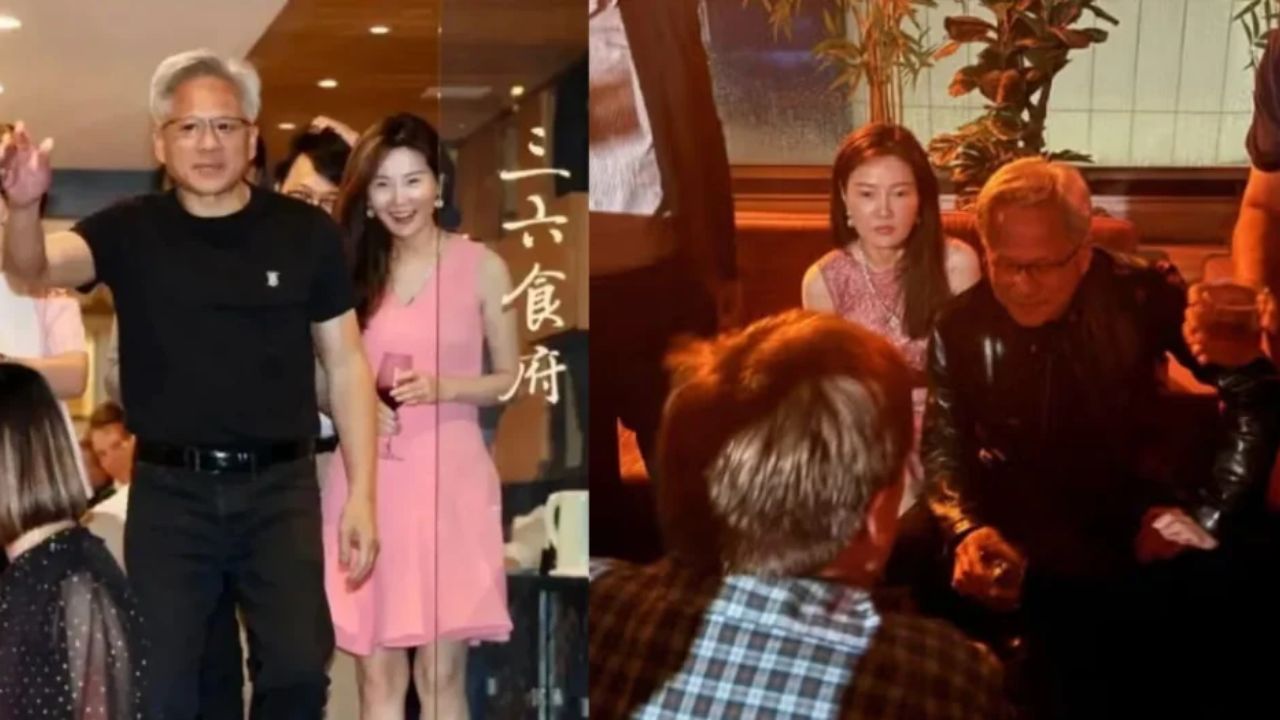
Alice Huang, who is unrelated to Jensen Huang despite sharing his surname, was photographed alongside the Nvidia chief at an industry gathering in Taipei in June 2024.
The photograph showed her sitting with Jensen Huang at a bar, where executives from Gigabyte and NetThunder were also present. Another public appearance followed in May 2025, when she was seen behind him outside a Taipei restaurant after a dinner with artificial intelligence suppliers.
At the time, a company associated with Alice Huang was expanding its purchases of advanced Nvidia equipment. Those transactions would later become part of a broader investigation into the movement of AI hardware through Southeast Asia.
US intelligence officials reportedly came to suspect that Alice Huang was sharing information with Beijing. A classified intelligence memo described by The New York Times and the Financial Times allegedly connected her to China’s Ministry of State Security.
The reports raised questions about whether she had been recruited to gather information about Nvidia’s leadership or influence the company’s position on selling advanced chips to Chinese customers.
Alice Huang did not respond to requests for comment from The New York Times.
Alice Huang’s Background and Business Connections
Alice Huang is also known as Huang Le. A profile attributed to her in a Chinese private-fund database describes a career that reportedly included positions at Hunan TV and China’s state broadcaster CCTV.
The same profile listed her as an assistant to the president of HSBC’s private banking division before she moved into a vice-presidential position at CITIC Securities.
However, questions have been raised about parts of her reported professional background. When The New York Post contacted a Hunan TV executive, he said he had never heard of her. The newspaper also reported that it could not find a corresponding profile on CCTV’s website.
Corporate records provide additional information about her business activities.
A Singapore-based company originally called 7Road International, which had connections to China’s mobile gaming industry, changed its name to Megaspeed in March 2023. Alice Huang joined the company as a managing director around the same time.
Ownership transferred to Huang Le Limited that month before moving to another newly established company, Swiftdata, in November 2023. Alice Huang had resigned as a director by then.
Her name also appeared in connection with Shanghai Hexi Investment Management, according to the reporting.
The New York Times examined a network of companies and investors in Shanghai and Zhejiang that reportedly moved from mobile gaming into artificial intelligence data centers.
The newspaper also reported that the network had an investment in a cybersecurity subsidiary of China Electronics Technology Group Corporation, a major Chinese military technology conglomerate.
Investors familiar with the business told the newspaper that Alice Huang and her associates had used her connection to Jensen Huang to raise money.
The $4.8 Billion in Nvidia-Related AI Equipment Purchases
One of the most significant parts of the investigation involves Megaspeed’s purchases of advanced computing equipment.
In early 2024, Megaspeed established a Malaysian subsidiary called Speedmatrix, with two offices in Johor. An earlier account placed Megaspeed’s commitment to Nvidia products at nearly $2 billion.
However, trade records cited by The New York Times indicated that Megaspeed’s Malaysian sister company purchased at least $4.8 billion worth of advanced AI equipment containing Nvidia chips between June 2024 and February 2026.
Megaspeed developed data centers in Southeast Asian countries, including Malaysia and Indonesia. The company also supplied computing capacity to Chinese customers, including Alibaba.
This business model attracted attention because Chinese companies could potentially access Nvidia-powered computing resources hosted outside China without having the physical chips shipped directly into the country.
US investigators were separately examining concerns that some of the hardware may have been illegally diverted to China.
Nvidia has said it complies with applicable laws and has found no evidence of smuggling.
Megaspeed was still listed as a cloud partner in late October. However, The Information reported that it was no longer listed as a preferred partner by the following Sunday.
US Intelligence Monitoring and the Jensen Huang Connection
The US Commerce Department began examining Megaspeed toward the end of the Biden administration.
During electronic monitoring of Alice Huang, intelligence agencies reportedly detected communications involving an American whose identity was initially concealed in classified records.
Officials later used a process known as unmasking to identify the individual. According to The New York Times, the person was Jensen Huang.
Former President Donald Trump was reportedly briefed about the matter roughly a year before the allegations became public.
According to the newspaper, Trump did not take action at the time because of concerns about disrupting Nvidia’s business, unsettling financial markets, and complicating trade relations with China.
Officials who initially briefed Trump reportedly did not believe Jensen Huang knew about Alice Huang’s alleged intelligence connections. However, some senior administration officials later questioned whether he could have remained unaware.
The reports also said Jensen Huang did not receive a formal warning of the type sometimes provided to Americans who may be targets of foreign intelligence operations. Surveillance was reportedly continuing in late October.
By the spring of 2026, Secretary of State Marco Rubio had overseen the preparation of a classified memo based on the surveillance, according to The New York Times.
The memo reportedly reached senior officials ahead of Trump’s May summit with Chinese President Xi Jinping.
People familiar with the document told the Financial Times that it described a romantic relationship between Jensen Huang and Alice Huang.
However, the available reporting does not establish when Beijing may have allegedly recruited Alice Huang or whether the alleged recruitment occurred before or after she became acquainted with Nvidia’s CEO. The date of their first meeting also remains unclear.
Nvidia’s China Chip Sales and Political Pressure
The controversy has also drawn attention to Jensen Huang’s influence over US semiconductor policy.
By September, Huang was seated at the head table during a White House state dinner for Chinese President Xi Jinping.
The New York Times reported that Nvidia had contributed at least $20 million to Trump’s ballroom fund. Huang had also become an influential advocate for easing restrictions on advanced chip sales to China.
Current and former officials told the newspaper that Huang’s access to Trump had made it more difficult to pursue stricter restrictions. Some Commerce Department investigations and proposed sanctions had reportedly stalled.
Congress was also raising questions about the administration’s approach to semiconductor exports.
One proposal involved allowing Nvidia to sell its H200 AI chips to China under an arrangement that included a 25% payment to the US government.
These developments have placed additional attention on the relationship between Nvidia’s business interests, US national security concerns, and Washington’s technology policy toward Beijing.
Jensen Huang’s Earlier Comments and Nvidia’s Independent Investigation
When The New York Times published its initial report on October 29, Nvidia described the meetings between Jensen Huang and Alice Huang as routine business interactions.
A company spokesperson said customers received ordinary business information and did not have access to trade secrets.
Jensen Huang also addressed the issue in an interview with Bloomberg, describing his interactions with Alice Huang in connection with Megaspeed as “completely normal and not unusual.”
Ten days later, Nvidia’s board of directors announced an independent investigation.
The investigation, which involves outside legal counsel, will examine whether the company’s CEO was targeted by foreign intelligence.
The board said it had no reason to believe that US national security or Nvidia’s confidential business information had been compromised. It also expressed confidence in Huang, who remains the company’s chief executive.
Huang subsequently sent employees an email acknowledging his infidelity and apologizing to his family, colleagues, board members, business partners, and shareholders.
In the message, he accepted responsibility for hurting his wife and children and said he hoped to rebuild their trust over time.
He also addressed the national security concerns, confirming his support for the board’s investigation and promising full cooperation.
Huang said he remained committed to Nvidia and to protecting the company’s interests and America’s national security.
He ended the message by asking employees and others to respect his family’s privacy, emphasizing that his family was not responsible for his decisions.
China and Singapore Respond to the Allegations
China’s embassy rejected the allegations, describing them as “groundless smears and slanders.”
Singapore’s Ministry of Home Affairs also disputed a Wall Street Journal account suggesting that authorities in the country suspected Alice Huang of being a Chinese intelligence source and had investigated her over those connections.
The newspaper had also asked about reports that she was questioned and released in 2025.
Singapore police have confirmed a separate ongoing investigation involving Megaspeed.
Megaspeed said it had hired outside legal counsel to conduct an investigation and informed the US government that it would cooperate.
The White House, CIA, and National Security Agency declined to comment to The New York Times. The newspaper also reported that the Commerce Department had referred the Megaspeed matter to the Justice Department in 2026.
Meanwhile, three Republican committee chairs in Congress have asked Jensen Huang to appear for a closed-door briefing scheduled for November 18. Democratic Senator Elizabeth Warren has also demanded answers from Huang and Nvidia’s board.
Questions Remain About Alice Huang’s Business and Nvidia’s Security
The controversy has raised several unresolved questions about Alice Huang’s business connections, her relationship with Jensen Huang, and the movement of advanced Nvidia equipment through Southeast Asia.
Trade records cited by The New York Times provide details about the scale of Megaspeed’s purchases. Intelligence reporting has raised separate concerns about whether Alice Huang was connected to Chinese intelligence activities and whether she could have obtained sensitive information through her relationship with Nvidia’s CEO.
However, the public reporting has not established that Jensen Huang knowingly shared confidential company information or that Nvidia’s national security protections were compromised.
Alice Huang’s current role at Megaspeed also remains unclear, and she has not publicly provided her account of the allegations.
For now, Nvidia’s independent investigation and the ongoing scrutiny from US authorities and lawmakers may help clarify what happened, whether any confidential information was exposed, and whether the company’s business relationships created national security risks.
Jensen Huang has apologized to his family and employees and pledged to cooperate with the investigation. The remaining questions about Alice Huang and the allegations surrounding Megaspeed have yet to be publicly resolved.
